Saturday, March 12, 2011

Puerto Viejo

Last weekend, Emily and I very early Saturday morning to catch the 6:00 am bus to Puerto Viejo. We tried to make this trip as cheap as possible which included packing many of our meals and staying at a cheaper hostel. We went grocery shopping Friday afternoon after family day at Central Commercial del Sur near my house. We walked past this rather peculiar chip sampling stand, and realized that it was going to be a crazy weekend. Puerto Viejo which means Old Port in Spanish, is located on the Caribbean side of Costa Rica in the province of Limon. Limon is where most of the indigenous peoples in Costa Rica live, and there is also a large African and Jamaican influence in the region.
After Emily and I saw this chips stand,
we started to wonder what our weekend on
 the Caribbean side of the country would be like. 
It was only about a four and a half hour drive from San José to Puerto Viejo. We made one "bathroom break" in the province's capital city of Limon. All of the provinces here in Costa Rica are named after their capital cities, San José being the country's capital. Once we got to Puerto Viejo, we were dropped off at the bus stop in town. We were already planning to stay at Rockin J's Hostel, and the website had advertised that they would pay any cab driver who brought a paying customer to Rockin J's. So, we hopped in a local cab (which was a little scary because Puerto Viejo does not have the red cabs with the yellow triangles like the rest of the country) and asked to go to Rockin J's. We found that there was a lot more diversity in the languages spoken in Puerto Viejo including a french creole and german, but we actually encountered a lot less English speakers also. It was good practice for Emily and I to really have to rely on our communication skills to get around a place we had never been before. When we arrived at Rockin J's, it was only about 10:30 in the morning. We could not decide if the party had already started or if was still going on from the night before... We paid $5 dollars each for a hammock, a sheet, and keys to a personal locker for our things. 

The entire place was very interesting and very crowded with backpackers and typical hostel goers. The bathrooms were a little gross, and there were a lot of empty bottles of alcoholic beverages lying around. However, it was a nice place to sleep for really cheap. Rockin J's was completely decorated in mosaics that past patrons had left behind. There was also an option of bring your own or staying in a provided tent.


At Rockin J's Hostel, we were given a locker, a hammock,
and a sheet for $5 a night.


Everything at Rockin J's was decorated in murals and mosaics
So, after locking up our stuff, we left through the back gate of Rockin J's which was literally twenty feet from the beach. There was a path in the woods along the beach that was about a kilometer walk to the center of town. We chose to walk right along the beach.


The trail in the woods beside the beach
This beach was not crowded just like Montezuma, but it was also the calmest beach I have seen in Costa Rica. The caribbean waters were warm and crystal clear. Due to the presence of an immense system of barrier reefs, the waves never actually crashed on shore. In fact, I was able to put my goggles on and swim right alongside tropical fish. It was also calm enough to just float on my back without fear of being pummeled by a wave or pulled out to sea by a riptide. They say that the Caribbean side of Costa Rica is a lot more laid back, but I had no idea. While swimming around, we got to play around with this little boy who spoke only the French creole. It seemed that the whole group of boys come to the beach everyday and play futbol in and around the water. This boy was a bit too small to play the older boy's games, and he was determined to play fetch with me. As in, he would throw a stick or piece of coral and expect me to go get it for him. It was hilarious!


Throughout the weekend, Emily was trying to complete her ecological photography class project. So, we tried to find some good places for her to take pictures for her chosen topic of "reflections." The scenery in and around Puerto Viejo was gorgeous. I especially liked spending time in the tide pools which were full of tropical fish, crabs, snails, coral, plants, etc. 


An old barge that washed ashore and became a habitat for plants. 


One of Emily's "Reflection" Pictures.

The cutest kids ever! There were no regulations as to where
 people could park their boats.
At one point, I was swimming, and someone
came and parked their boat right beside me!
Later, after swimming, walking,  and relaxing for hours on the beach we decided it was time to get some dinner. We had already eaten our packed breakfast and lunch. We decided to check out the creperie that had been recommended to us by friends. Like many good things in Puerto Viejo, the creperie was not at all advertised, and we had a hard time finding it. Luckily, we did, because it was the most delicious thing ever! We both ordered batidos con leche y piña or what is kind of like a pineapple milkshake (it is a lot better than it sounds) and crepes. The crepes were filled with bananas and a little bit of nutella. The outside was covered in homemade chocolate. There was even a fresh piece of starfruit to go along with the perfect snack.
The BEST crape ever!
That night, we had a chance to enjoy the vibrant night life of Puerto Viejo, which was especially fun because a lot of our friends had also decided to come to Puerto Viejo for the weekend. We attempted to go to bed at one point, but Rockin J's was "Rockin" a little too much. So, with the help of my trusty earplugs, we were able to get a few hours of sleep in the hammock jungle. 

The next morning, we woke up early to catch the Caribbean sunrise while eating the cereal we had packed. Afterwards, we walked through town checking out all of the cute shops and the street venders. A number of our friends had been to a Cacao house with a witch that sells really good chocolate, cocoa butter, and cacao jewerly. Just like the creperie, it was almost impossible to find. There was an expensive tour that you can take with the BriBri indian tribe, and everyone thought that we were talking about that. We finally got a little fed up with the lack of understanding, that I said I would check just one more place. We went to the Cari BEANs coffee and chocolate shop in town hoping that they would know about their own competition. The man knew exactly what I was talking about. He gave me directions (which ended up being very wrong), but at least I knew what to ask the cab driver.

We went to the same cab driver that had taken us to Rockin J's, and asked to go to the Cacao House. It was on an unmarked road (typical..) up the side of a mountain. We went inside to meet the self-proclaimed witch. She demonstrated a number of things involved with the chocolate making process including how banana leaves can be strengthened for use in construction and basket making. Apparently, the banana leaves do not actually burn in the fire, but they melt. So, if you let a banana leaf melt in a fire for ten seconds, it becomes flexible and strong. The woman's house was literally a dirt floor glorified hut., but it was beautiful. After her talk, we got to sample some of the different types of chocolate. I got a container of cocoa butter that is supposed to help some of my scars. We both got different types of chocolate...my favorite was the chocolate with cas. I also got a beautiful bracelet that was made out of cacao seeds.


The entrance to the Cacao House.
The Cacao House.
After one night at Rockin J's, we decided to take the late Sunday night bus home instead of the early Monday morning bus home. It also seemed like it was going to start raining soon, and we were sure that the open atmosphere of Rockin J's would not be quite as much fun in the rain. So, we spent the rest of the day enjoying the relaxing beach, and we caught the late bus back to San José. Now I can say that I've swam in the Atlantic, Pacific, Red Sea, Mediterranean Sea, and the Caribbean!


Another self-planned trip...SUCCESS!!!

Friday, March 11, 2011

Family Day at Universidad Veritas

On Friday, Universidad Veritas held its first official family day for international students and their Tica Families. My tica mother, Marisol and I went to the family day together at a park near my school. We wanted to bring along my sister Sophia, but she had to go to her preschool. Everyone's host mothers and fathers brought along typical Costa Rican dishes to add to the enormous buffet at the event. I got to meet a lot of my friends' host families, and my host mom got to meet a lot of my friends who have not yet been over to my house. At the event, there was Costa Rican music and typical games. I even won the stilt race! For lunch, I had some amazing gallo pinto with sour cream, arroz con leche, plantains, iced tea, and some different types of salad.

Winning the stilt race!
I also got to see Emily's host mother Ana again. Ana was very nice and invited me over one night for dinner. She made a beautiful salad, chicken and rice, nachos, homemade juice, and tres leches for desert.

I spent most of the day on Friday hanging out with my host family. For dinner, we all ate a wonderful dish of nachos. Usually, I have class until 8pm, and Sophia goes to bed before I return. This was one the first times since Sophia went back to school that I have been able to eat with my whole family together. Sophia and I also had a fun time trying to spot some of the lizards that live in the living room. All of the lizards make really loud screeching sounds, and we found one that has been wondering around without a tail. I recently found out that there is one living in the ceiling above my room that occasionally likes to hang out behind the painting on my wall.

Tuesday, March 8, 2011

Tropical Ecology Field Trip to Santa Rosa

My second Tropical Ecology field trip was to Santa Rosa. Santa Rosa natural reserve located in northwest Costa Rica along the Pacific coast. It encompasses a number of different types of ecosystems. For our field trip, we focused specifically on the tropical dry forest, because we had focused on the tropical rain forest while in La Selva. We stayed at the national park's facilities, which were similar to the Biological station's facilities. We had gallo pinto at each and every meal, and we had to constantly check under our mattresses and in our shoes for scorpions and tarantellas. I saw more scorpions, tarantellas, scary bees, biting ants, and poisonous snakes than I ever wanted to see in my lifetime. It was very interesting, however. This time, our whole class was not able to go on the field trip because there was a Marine Biology field trip scheduled for the same amount of time. Only having 11 kids and one professor made the 6 hour bus ride a little more relaxing (we all could sprawl out on our own seats). We stopped on the way to Santa Rosa for breakfast, which turned into naranja-piña ice cream time. It is my new favorite flavor, but I still really like Cas ice cream. 

Santa Rosa was the hottest place I have been to so far. When we arrived, it was a little past lunchtime. The lunch ladies still let us have our first dose of gallo pinto for the weekend, but there was also amazing fresh fruit and mora juice. After lunch we went on a walk to Costa Rica's only legitimate battle field. Costa Rica, having no army for the past few decades, does not have a lot of war history. It is a relatively peaceful country despite having less peaceful neighbors. The battle was called the battle of Santa Rosa, and it is where the Costa Rica's only national hero, Juan Santa Maria became famous. We got to tour part  of the original farm house where the battle took place. Unfortunately, a lot of the house was purposely burnt down by some angry hunters a few years back. The fire destroyed a lot of important artifacts. The hunters were mad that they had been fined for hunting. (Hunting is absolutely illegal in all of Costa Rica except for some indigenous tribes) The two hunters are still in jail. 

The history was interesting, and we also got to learn a lot about the national park. Actually, if it were not for the importance of the battle, there would be no national park. The battle was against people from Nicaragua, but they were not actually Nicaraguans. There are still a lot of tensions between Costa Rica and Nicaragua to this day. Apparently, Nicaragua has been doing some environmental damage at the San Juan river in northern Costa Rica. It certainly does not help a relationship that is already full of prejudice. 

Naked Indian Tree
Along the way, we saw a number of plants and animals native to the dry forest. Above is a naked indian tree. The dry forest is the only ecosystem in Costa Rica where the plants lose there leaves. This tree is rare because the bark can be pealed back to reveal a photosynthetic layer. So, when the leaves are gone, the tree can still preform photosynthesis. The tree below is home to many species of ants and bees. It has also lost many of its leaves, and it was FULL of iguanas.
One of the primary forest trees
 typical of a tropical dry forest
After we toured the Santa Rosa memorial site, we climbed to the top of an observation spot. We were able to see for miles, the whole way to the ocean. This is when we asked our professor, Daniela, if we could take a hike to the ocean. Surprisingly, she agreed. She said that the hike was really long, but it was not to strenuous....what a lie. Haha... The view was incredible though. We were also able to see a number of nearby volcanos, although they were covered by a thick layer of clouds.

The view of the surrounding mountain range.

The war memorial at Santa Rosa


On top of the world!
When we got back, we ate dinner. Dinner consisted of...gallo pinto. After dinner, we went for a quick night hike to explore the different animals that are more active at night. The stars were absolutely amazing. They were even better than the ones I had seen in Cherry Springs, Pennsylvania. There was no light pollution for miles and miles, and there was virtually no humidity because we were in a dry forest. One of the more memorable things from the hike was seeing a male and female scorpion. The female was trying to eat the male, and the whole time she had about a hundred tiny baby scorpions on her back. It was crazy to watch!

After the short hike, we quickly went to bed. At about 3:45 am, we woke up and got ready to leave for our long hike to the beach. Everybody had to go, and those of us who suggested it felt bad for making our classmates go. Everybody was a good sport about it at first. We walked for about an hour in a half in a close group using flashlights to check for snakes and scorpions. Eventually the sun rose, and we were able to spread out a little more. Right after sunrise, all of the tropical birds came out. Their songs were absolutely beautiful.


The dry forest at about 5am, the air was filled
 with the songs of tropical birds.
As time went on, it got hotter and hotter. After a few miles, we started going down steep hills. All the while, we were quite aware that we would have to climb back up these hills later when we would most certainly be more tired and hot. The steep downhill lasted for a couple of miles. We stopped to eat breakfast at about 7am. All around us there were Howler monkeys, and a couple of them threw their own poop at us. We kept walking and saw a large group of White faced monkeys. One of them was even caring an infant on its back.

We saw dozens of monkeys including Howler's and
 White faced monkeys.
 This is one of the white face monkeys.
We finally reached the ocean at about 8:40, and we stayed until about 10am. The beach was called playa naranja, and we were the only ones on it. It was definitely worth the walk and the sweat to see such a beautiful, pristine beach.

My friend Isaac, my professor Daniela, and I enjoying the beach


Playa Naranja
Unfortunately, we had to leave the beach to start our 10 mile journey back to the cabins. The way back was a lot hotter, and it was all uphill. There was zero cloud cover, so I had to keep reapplying sunscreen every half hour or so. We walked quite quickly and made it back by 12:15 in time for lunch. After lunch, we got back in the bus for a 7 and a half hour drive back to San José. Needless to say, I was a little sore when I went to walk back to my house after getting off that bus. We tried to convince Daniela that the 20 mile hike should be enough, and we should not have to write our field reports. She said that she did not have any sympathy because she is older and in more pain that we were. Overall, I really enjoyed my trip to Santa Rosa.

Friday, March 4, 2011

Visit to Cartago and the Lankester Botanical Gardens

This weekend, I did not have to leave for my Tropical Ecology field trip until 6 am on Saturday. So, I got to go on a day trip with AIFS to Cartago. Cartago is a more colonial city located in the province of Cartago, south of San José. The majority of the population of Costa Rica lives in the cities of Heredia, Cartago, and San José. There are a number of other smaller cities in other provinces, but these are the main ones.

We met in the morning and took a Tico Viajero bus to Cartago. Tico Viajero is the main organizer of excursions for international students at Universidad Veritas. AIFS does everything separately, because Tico Viajero is notoriously expensive. However, I do appreciate the shuttle services that are provided by Tico Viajero after my night classes to my house. I have a longer walk than anyone, and petty theft is very common in San José. I have only had one thing stolen so far, and that was on a public bus. I probably have Tico Viajero to thank for the fact that I am still in possession of my backpack...and my orange rape whistle (Thank you Aunt Gina!!! It did come in handy)

The ride to Cartago was about forty-five minutes, and we had a beautiful view of the famous volcano, Irazú. Cartago was the first capital of Costa Rica, and it remained the capital until 1823 when it was moved to San José. The city has had a number of hardships in the past. It suffered severe damage in earthquakes in 1822, 1841, and 1910. In 1963, there was a major volcanic eruption of Irazú that lasted for two years. The eruption covered Cartago and San José in ash and damaged a lot of agricultural areas.

The "new" basilica
Our first stop in Cartago was the Basilica de Nuestra Señora de Los Ángeles. Costa Rica is a predominately Catholic country, especially in the San José region. The Basilica is the most famous church structure in the country. Every year on August 2, pilgrims travel to celebrate the feast day of the Virgin of the Angels in Cartago. Costa Rica's principle church is the Basilica de Nuestra Señora de Los Ángeles. The church has a statue of the Black Madonna that is called La Negrita in the lower level. People believe that she has healing powers.

This is the statue of La Negrita on top of the stone.
This is where the pilgrims toss their charms.
The story is that the statue of La Negrita was found by an indigenous girl in 1634. The rock where she found it is now held in the basilica, and it is revered as a sacred relic. It is supposed to be in the same location it was when La Negrita was found. However, the old basilica was damaged in all three earthquakes, and rebuilt in a different location. Whenever the pilgrims come to the church, the walk on their knees down the center aisle of the church while praying. We saw a couple of people doing this in the church even though it was only February. We also saw a collection of thousands and thousands of charms that people have brought to La Negrita. For example, there were charms of legs, arms, heads, hearts, etc. People bring the charm and then throw it at the rock in hopes that La Negrita will answer their prayers. It is funny though, I cannot find a charm for my charm bracelet in this country for the life of me...
A woman doing the traditional "walk" to the altar.

After visiting the Basilicia, we travelled to the Lankester Botanical Gardens. The Botanical gardens were incredible and really displayed the floral biodiversity of Costa Rica.

This is my resident director Rebe and her daughter
 Mara at the botanical gardens.

I took dozens of pictures of gorgeous flowers.
A lot of them were really exotic looking like this one.

Butterfly Garden

On Wednesday, my resident director took all of the AIFS students on a short trip downtown to the Butterfly Garden. When I heard that there was a butterfly garden downtown, I did not know exactly what to think. How would a butterfly garden look amidst the three or four tall buildings and hustle and bustle of downtown? (There are only a few tall buildings because of the frequent earthquakes...don't get me wrong, San José is a big city) We took a shuttle bus from Veritas to the butterfly garden. It did not look like anything special from the outside.

We walked in the reception building, and one of the staff members gave us a presentation on the facility. She told us a lot of information we had already figured out after two months. Costa Rica is one of the most ecologically friendly countries on the planet, but you would not know it if you only visited San José. San José is just like any other city. It is surrounded by a gorgeous mountain range that contributes to its cooler weather, but the city itself has a lot of poverty. There is still litter on the streets and that "smell" that many big cities seem to have. The purpose of the butterfly farm was to create a small haven for people in the city to experience the biodiversity and beauty of Costa Rica while still in the city. In addition to the butterfly garden, there is also preserved forest. (All of this in the busiest part of downtown)

After the introduction and a short video, we got to walk out into the enclosed butterfly garden. ¡Que bonita!  There were hundreds of different types of butterflies and plants. There were also a number of fountains and small pools within the enclosure. The butterflies would just land on us as we walked through the garden. I was impressed...

Then, we walked out of the enclosure into the forest reserve. I honestly forgot that I was in downtown. All I could hear was the flow of the river and the chirping of birds. It was like I was in La Selva! I definitely was not expecting much when I heard we were going to a butterfly garden, but the garden and preserve were gorgeous. I hope that other cities around the world will follow San José's example and promote such projects in urban areas.

Earthquake and Tornado

I love the Geography of Hazards. In fact, I am thinking about concentrating in it when I go to Grad School. Costa Rica seemed like a perfect place to see some of these things first hand. San José is in a prime location to experience frequent earthquakes. We are within a hundred miles of four active volcanos and a whole bunch of dormant ones. Both the Caribbean and Pacific coasts can experience small tsunamis due to the abundance of earthquakes. My host dad has been telling me for weeks that San José has not had a significant earthquake in a long time...they feel an earthquake at least once a month. He expected that I would definitely feel one before I left, and it might be stronger since there has not been one in a while. Of course, the earthquake happened when I was still in Alajuela at the Pineapple Farm!!! It was not significant, and there was not any damage. Many of my friends did say that they felt it and heard it. I was a little disappointed that I missed it...

To top it all off, I missed the tornado too. If you think that the United States is the only place that gets tornados, think again. I came home from school one day, and there had been some storms in the area. Apparently a small tornado took the roof off of my neighbor's house! My host mom and sister were at home at the time and said the sky got really dark and they heard a really loud noise. We all figured it was just heavy straight winds, but my next door neighbor told my host dad that a few people had seen a funnel cloud. My host grandparents live directly behind us, and the damaged house was right next to theirs. The witnesses said that the tornado took the roof off, it flew over my grandparent's house, and landed upside down on the next house over. I came home in time to see the damage. My windows in my bedroom had been open at the time, and I walked upstairs to find my curtains laying on the floor and a lot of my things blown around the room. Apparently the incident made the San José nightly news. 

Wednesday, March 2, 2011

Jorge's Pineapple Farm and Ciudad Casada

Melissa and I embarked on our second self-planned journey. She works for a company in Wisconsin, and one of her business connections Jorge owns a pineapple farm in Alajuela. So, we decided to spend a weekend visiting him and his family. Early Saturday morning we took a taxi to the San Carlos/ Ciudad Casada bus station in downtown San José. The first bus that was direct was full. Luckily, we were able to get on a different bus to Ciudad Casada as long as we were willing to endure a few stops. The bus ride was about three hours long. However, unlike other buses I have been on in Costa Rica, we were the only non-nationals on the bus. That was a whole new, eye-opening experience in itself. 
On the way to Ciudad Casada, we passed through a lot of Alajuela, one of the seven Costa Rican provinces that I had not had a chance to explore yet. Alajuela is a province where there are a number of smaller towns that are a little more well to do like Ciudad Casada and San Carlos. We drove over a couple of mountains and past a few volcanoes. We experienced one white out (which are common in Costa Rica due to the cloud forests and the humidity). That made me a little nervous on the two way, windy, steep roads. 

When we arrived in Ciudad Casada, our first attempt to use a Costa Rican public pay phone was a fail. Luckily, we found another one, and we were able to meet Jorge and walk to his house in town. Jorge's house in town was bigger than any other residential house I have been to so far in Costa Rica. It actually had a front yard, a typical tiled front porch, and even a backyard. The house was well decorated with a number of artisan crafts from all of Jorge's travels. It seems that Jorge has been EVERYWHERE. When we met up with him, he had just returned the night before from Brazil. 

This is a picture we took right before Melissa
and I left with Jorge and Maura.
We went inside and met the muchacha from Nicaragua, his father, one of his nine brothers, and two of his children. We had the opportunity to meet his daughter briefly, but we spent most of the weekend with his nineteen year old son Daniel. Jorge, Daniel, Melissa and I went to the Dos Pinos plant just outside of town to pick up some medicine for the cows at the farm. Dos Pinos is the big dairy provider in Central America. Its kind of like Swiss and Turkey Hill, but its the only one. We get Dos Pinos yogurt, ice cream, milk, sour cream, queso crema, cheese, and a whole bunch of other products. Jorge is starting a milk, cheese, and sour cream production at his farm, and he is hoping to get a contract with Dos Pinos. It was really cool to see the factory from a Tico farmer's point of view. 
If you look in the middle of the picture, there is a concrete wall with the
 Dos Pinos emblem on it. Dos Pinos means "Two pines" in English. 
From almost anywhere within the city limits of Ciudad Casada, we were able to see the dormant volcano pictured below. Jorge was actually born at his parents' farm on the side of the volcano. A couple of his brothers and his cousins still have farms on the side of the volcano towards the top. On our first day, Jorge pointed out the volcano a lot and told us stories of his childhood. On our last day, before driving us to the bus station, Jorge drove us to his cousin's farm. It was one of the farms with the highest altitude. Unfortunately, I do not have any pictures from that adventure, because the humidity did not allow my camera to take any clear pictures. However, we were to look south the whole way to Lake Nicaragua. Within in our field of view, we were also able to see a number of volcanos including the magnificient Arenal volcano. Jorge also pointed out five or six cities that we were able to see. It was probably the most amazing view I have seen since I have been in Costa Rica. If I were to move down here, that's where I would want my house to be. Although the altitude did make it a little difficult to breathe. Ciudad Casada is even higher above sea level than San José.


After showing us the Dos Pinos factory and a Home Depot type store, we went back to the house to eat lunch. La Muchacha made a typical South American dish. It was a spicy soup where you added chicken, avocado, tortilla chips, cheese, and a whole bunch of other ingredients. It was amazing! Of course, like any good Costa Rican meal, there was Gallo Pinto on the table. Gallo Pinto is served at every meal including breakfast. Ticos are OBSESSED with it. Luckily, my host family is a bit more Americanized, so I get more variety with my meals in San José. Gallo pinto is starting to grow on my though, because I have it at every meal on the weekends. Who knows? I might get home and start craving gallo pinto all the time. After lunch, we packed up the car for the two hour drive to the farm. 

The drive was long and hot. We picked up Maura on the way. She is a thirty year old woman that has been helping out the family since the kids were little. In exchange for her cooking for us for the weekend, we helped out with her job. Apparently her job is legal in Costa Rica. She buys jeans and other clothes from San José and sells them out of her house. When she goes to the farm, she takes some along. We drove around with her as she collected money from some of her customers in the town around the farm. It was really interesting to see some of the houses and people in such a rural, poorer area of Costa Rica. 

Jorge reminded me a lot of my Papa. We made a million stops on the way to the farm so that he could pick out the perfect ingredients for the dinner. Sometimes we would stop so he could talk to some random people that he knew. We even stopped at this one tourist attraction where there were a whole bunch of Iguanas. Iguana is a typical Costa Rican dish, but it is illegal now in some parts. 


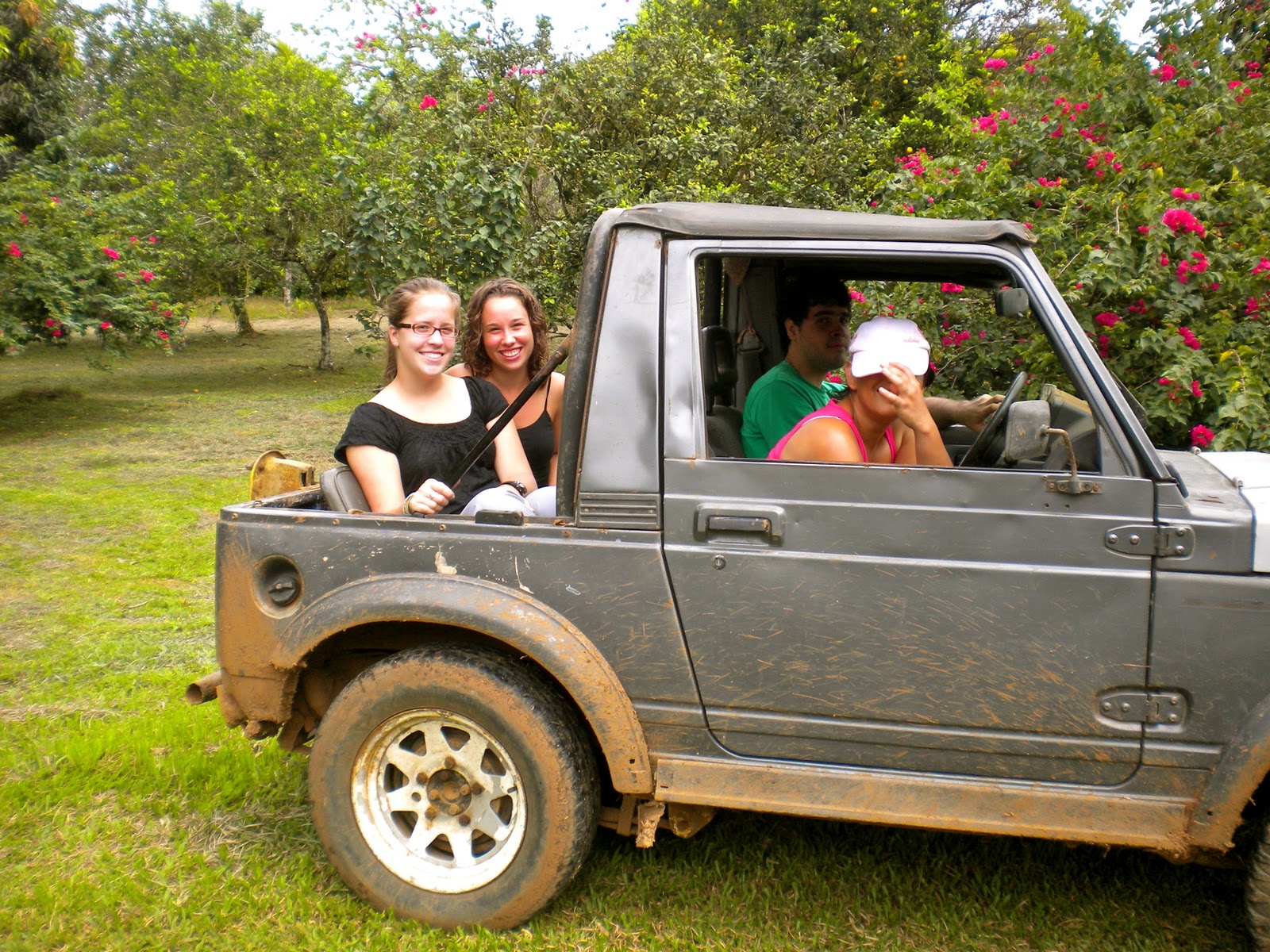
We finally got to the farm about an hour before sunset. We switched vehicles to the open top jeep. Daniel warned Melissa and I that the suspension was shot in the Jeep and to hold on tight. Driving around the farm in the jeep was the most intense off-roading I have ever experienced! The four of us drove out to a part of the farm that Jorge was renting out to a different farmer and stole some of the Yucca. Jorge said that he did not like the guy anyway, so I guess it was okay. The Yucca is kind of like a really tasty potato that grows on the Tapioca plant. Apparently these Tapioca plants have nothing to do with the creation of Tapioca pudding, but I am not convinced. 


We had a very tastey stew for dinner with Maura, another farm worker, Jorge, and Daniel. Jorge has about thirty Nicaraguan employees that live on the farm. We got to stay in the "Farm House". The farm house was even bigger than the house in Ciudad Casada. It was decorated with beautiful marble and other things from around the world. We ate on the deck that looked over the river, but we did not really get a good view of the farm until the morning.

The next morning we went out and picked oranges and other fruits for breakfast. Jorge showed us around his personal tree collection. There were a whole bunch of exotic trees from other countries like India, Angola, Thailand, Brazil, etc. Do not ask me how he got them past customs. We made fresh orange juice for breakfast. The oranges in Costa Rica are actually more yellow in color, but they are still very tasty. For breakfast I had Gallo Pinto with the farm's sour cream. It had a whole bunch of onions and peppers in it. My eggs also had onions and peppers in it, and I also ate whole mushrooms. Most people who know me know that I am an extremely picky eater. I am proud to say that I ate everything that was served to me the entire weekend. I have actually grown very fond of papaya also. It took a little while, but it is definitely growing on me.


After breakfast, we went on a tour of the pineapple fields with Maura and Daniel in the jeep. Maura does not like her picture taken... 


I do not know what I was expecting when I was told that I was going to a pineapple farm, but I definitely think that Spongebob Square pants led me wrong. Pineapples grow out of the ground, not on trees. In fact, after the pineapple is picked, the workers cut off the green top and replant it. That is what grows and produces the next pineapple.

Pinapples as far as the eye can see!
Picking prickly pineapples

These ones were not yellow enough yet.

We picked all of these. I had scratches all up my arms.
Pineapple picking is not an easy task.
This is the pineapple I brought back for my family!
After we got back from pineapple picking, we went out to see the crocodiles in the river. They were pretty cool. We also got to see all of the cows and the calfs. We even got to watch the workers making the cheese, and of course there was a little left to sample. ¡Que riquisima!


When we got back from our adventures, we helped the girls make lunch. Melissa and I made the pineapple juice. The best part of making pineapple juice, quality control. We had to test every single pineapple to make sure it was sweet enough...that was my favorite job. After lunch, we went horseback riding with Maura. The only problem was that the horses were not well-trained. I would be curious to know if they were even trained at all. My horse did not know how to stop. Melissa said that she was glad that I was a horse person because anyone else would have fallen off or freaked out. The horse was crazy! We got a beautiful view of the whole farm, even if it was at a gallop. Let's just say... I had a hard time walking the next couple of days. 

Before the horse went crazy!

I can't believe I survived!

The farm house, it was so amazing on the inside. 

Melissa and I had a few "friends" living in
the room across the hall.
Sunday night, we drove back to Ciudad Casada. We did not leave until noon on Monday, because Melissa and I did not have class until Monday evening. Spending the weekend with Jorge was a once in a lifetime experience, and it was probably one of the coolest things I have done so far in Costa Rica.