Wednesday, March 2, 2011

Jorge's Pineapple Farm and Ciudad Casada

Melissa and I embarked on our second self-planned journey. She works for a company in Wisconsin, and one of her business connections Jorge owns a pineapple farm in Alajuela. So, we decided to spend a weekend visiting him and his family. Early Saturday morning we took a taxi to the San Carlos/ Ciudad Casada bus station in downtown San José. The first bus that was direct was full. Luckily, we were able to get on a different bus to Ciudad Casada as long as we were willing to endure a few stops. The bus ride was about three hours long. However, unlike other buses I have been on in Costa Rica, we were the only non-nationals on the bus. That was a whole new, eye-opening experience in itself. 
On the way to Ciudad Casada, we passed through a lot of Alajuela, one of the seven Costa Rican provinces that I had not had a chance to explore yet. Alajuela is a province where there are a number of smaller towns that are a little more well to do like Ciudad Casada and San Carlos. We drove over a couple of mountains and past a few volcanoes. We experienced one white out (which are common in Costa Rica due to the cloud forests and the humidity). That made me a little nervous on the two way, windy, steep roads. 

When we arrived in Ciudad Casada, our first attempt to use a Costa Rican public pay phone was a fail. Luckily, we found another one, and we were able to meet Jorge and walk to his house in town. Jorge's house in town was bigger than any other residential house I have been to so far in Costa Rica. It actually had a front yard, a typical tiled front porch, and even a backyard. The house was well decorated with a number of artisan crafts from all of Jorge's travels. It seems that Jorge has been EVERYWHERE. When we met up with him, he had just returned the night before from Brazil. 

This is a picture we took right before Melissa
and I left with Jorge and Maura.
We went inside and met the muchacha from Nicaragua, his father, one of his nine brothers, and two of his children. We had the opportunity to meet his daughter briefly, but we spent most of the weekend with his nineteen year old son Daniel. Jorge, Daniel, Melissa and I went to the Dos Pinos plant just outside of town to pick up some medicine for the cows at the farm. Dos Pinos is the big dairy provider in Central America. Its kind of like Swiss and Turkey Hill, but its the only one. We get Dos Pinos yogurt, ice cream, milk, sour cream, queso crema, cheese, and a whole bunch of other products. Jorge is starting a milk, cheese, and sour cream production at his farm, and he is hoping to get a contract with Dos Pinos. It was really cool to see the factory from a Tico farmer's point of view. 
If you look in the middle of the picture, there is a concrete wall with the
 Dos Pinos emblem on it. Dos Pinos means "Two pines" in English. 
From almost anywhere within the city limits of Ciudad Casada, we were able to see the dormant volcano pictured below. Jorge was actually born at his parents' farm on the side of the volcano. A couple of his brothers and his cousins still have farms on the side of the volcano towards the top. On our first day, Jorge pointed out the volcano a lot and told us stories of his childhood. On our last day, before driving us to the bus station, Jorge drove us to his cousin's farm. It was one of the farms with the highest altitude. Unfortunately, I do not have any pictures from that adventure, because the humidity did not allow my camera to take any clear pictures. However, we were to look south the whole way to Lake Nicaragua. Within in our field of view, we were also able to see a number of volcanos including the magnificient Arenal volcano. Jorge also pointed out five or six cities that we were able to see. It was probably the most amazing view I have seen since I have been in Costa Rica. If I were to move down here, that's where I would want my house to be. Although the altitude did make it a little difficult to breathe. Ciudad Casada is even higher above sea level than San José.


After showing us the Dos Pinos factory and a Home Depot type store, we went back to the house to eat lunch. La Muchacha made a typical South American dish. It was a spicy soup where you added chicken, avocado, tortilla chips, cheese, and a whole bunch of other ingredients. It was amazing! Of course, like any good Costa Rican meal, there was Gallo Pinto on the table. Gallo Pinto is served at every meal including breakfast. Ticos are OBSESSED with it. Luckily, my host family is a bit more Americanized, so I get more variety with my meals in San José. Gallo pinto is starting to grow on my though, because I have it at every meal on the weekends. Who knows? I might get home and start craving gallo pinto all the time. After lunch, we packed up the car for the two hour drive to the farm. 

The drive was long and hot. We picked up Maura on the way. She is a thirty year old woman that has been helping out the family since the kids were little. In exchange for her cooking for us for the weekend, we helped out with her job. Apparently her job is legal in Costa Rica. She buys jeans and other clothes from San José and sells them out of her house. When she goes to the farm, she takes some along. We drove around with her as she collected money from some of her customers in the town around the farm. It was really interesting to see some of the houses and people in such a rural, poorer area of Costa Rica. 

Jorge reminded me a lot of my Papa. We made a million stops on the way to the farm so that he could pick out the perfect ingredients for the dinner. Sometimes we would stop so he could talk to some random people that he knew. We even stopped at this one tourist attraction where there were a whole bunch of Iguanas. Iguana is a typical Costa Rican dish, but it is illegal now in some parts. 


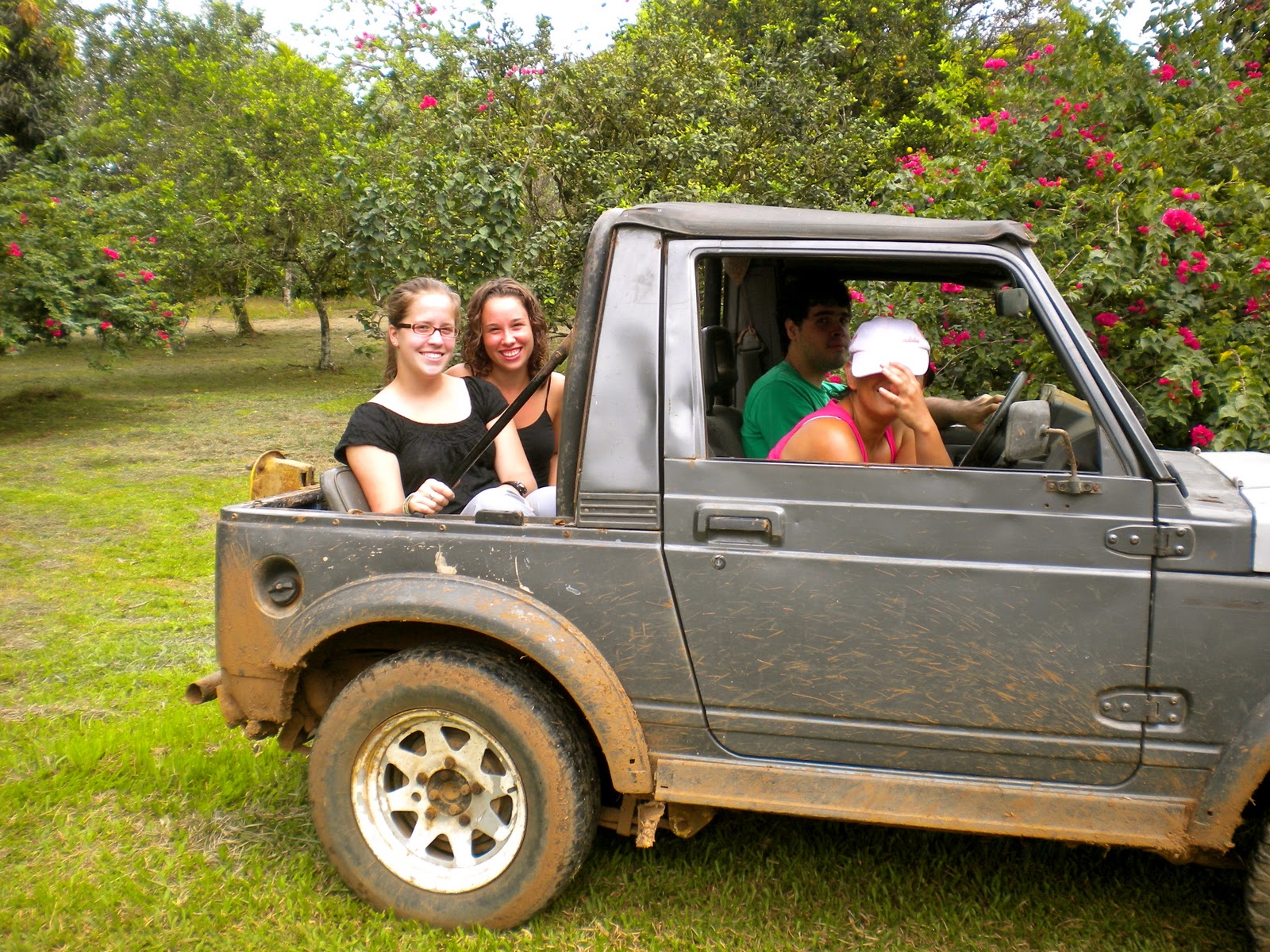
We finally got to the farm about an hour before sunset. We switched vehicles to the open top jeep. Daniel warned Melissa and I that the suspension was shot in the Jeep and to hold on tight. Driving around the farm in the jeep was the most intense off-roading I have ever experienced! The four of us drove out to a part of the farm that Jorge was renting out to a different farmer and stole some of the Yucca. Jorge said that he did not like the guy anyway, so I guess it was okay. The Yucca is kind of like a really tasty potato that grows on the Tapioca plant. Apparently these Tapioca plants have nothing to do with the creation of Tapioca pudding, but I am not convinced. 


We had a very tastey stew for dinner with Maura, another farm worker, Jorge, and Daniel. Jorge has about thirty Nicaraguan employees that live on the farm. We got to stay in the "Farm House". The farm house was even bigger than the house in Ciudad Casada. It was decorated with beautiful marble and other things from around the world. We ate on the deck that looked over the river, but we did not really get a good view of the farm until the morning.

The next morning we went out and picked oranges and other fruits for breakfast. Jorge showed us around his personal tree collection. There were a whole bunch of exotic trees from other countries like India, Angola, Thailand, Brazil, etc. Do not ask me how he got them past customs. We made fresh orange juice for breakfast. The oranges in Costa Rica are actually more yellow in color, but they are still very tasty. For breakfast I had Gallo Pinto with the farm's sour cream. It had a whole bunch of onions and peppers in it. My eggs also had onions and peppers in it, and I also ate whole mushrooms. Most people who know me know that I am an extremely picky eater. I am proud to say that I ate everything that was served to me the entire weekend. I have actually grown very fond of papaya also. It took a little while, but it is definitely growing on me.


After breakfast, we went on a tour of the pineapple fields with Maura and Daniel in the jeep. Maura does not like her picture taken... 

I do not know what I was expecting when I was told that I was going to a pineapple farm, but I definitely think that Spongebob Square pants led me wrong. Pineapples grow out of the ground, not on trees. In fact, after the pineapple is picked, the workers cut off the green top and replant it. That is what grows and produces the next pineapple.

Pinapples as far as the eye can see!
Picking prickly pineapples

These ones were not yellow enough yet.

We picked all of these. I had scratches all up my arms.
Pineapple picking is not an easy task.
This is the pineapple I brought back for my family!
After we got back from pineapple picking, we went out to see the crocodiles in the river. They were pretty cool. We also got to see all of the cows and the calfs. We even got to watch the workers making the cheese, and of course there was a little left to sample. ¡Que riquisima!


When we got back from our adventures, we helped the girls make lunch. Melissa and I made the pineapple juice. The best part of making pineapple juice, quality control. We had to test every single pineapple to make sure it was sweet enough...that was my favorite job. After lunch, we went horseback riding with Maura. The only problem was that the horses were not well-trained. I would be curious to know if they were even trained at all. My horse did not know how to stop. Melissa said that she was glad that I was a horse person because anyone else would have fallen off or freaked out. The horse was crazy! We got a beautiful view of the whole farm, even if it was at a gallop. Let's just say... I had a hard time walking the next couple of days. 

Before the horse went crazy!

I can't believe I survived!

The farm house, it was so amazing on the inside. 

Melissa and I had a few "friends" living in
the room across the hall.
Sunday night, we drove back to Ciudad Casada. We did not leave until noon on Monday, because Melissa and I did not have class until Monday evening. Spending the weekend with Jorge was a once in a lifetime experience, and it was probably one of the coolest things I have done so far in Costa Rica.

Tuesday, March 1, 2011

Baking Night!

Although I have made a few friends in my American Institute of Foreign Study group or AIFS, I have found that most of my close friends are actually independents. Due to the fact that I was the only AIFS person to be placed in a house by myself, and my house is further than anyone else's from Veritas, it was easy to fall into another group. And I could not be happier :) On Friday night, I was invited to an all girl's baking night at Bethany and Kalifa's house. It is always cool to meet other Tica families and to see how they interact with their host kids. There were about ten of us crammed into the modestly sized kitchen. We baked two batches of cookies and a fruit pizza. Of course, we hit a few road blocks along the way including altitude temperature adjustment (since we are much higher above sea level than at home). We also had to figure out metric and Centigrade conversions. The Tica mother made us the most delicious cold milk chocolate drink. It was like nothing I ever tasted before. She taught me how to make it, so hopefully I will be able to recreate it when I get home. No promises... At one point we realized that we were one stick of butter short. Bethany, her host dad, and I took a walk to a nearby corner store to pick up a stick of butter.  It was a great night, but Melissa and I had to leave a little early so that we could pack for our next adventure.

Project Outside of Campus

On Thursday, I went on a field trip to the San Pedro Mall during my Intercultural Communications and Competence class to secretly observe Ticos during their lunchtime. We went to the mall food court and ordered food to try to mask the fact that we were actively observing and taking notes. I found this interesting (even though it was rather awkward...) because I did the same activity while in a mall in Alexandria, Egypt. I did not formally take notes in Egypt, but I noticed a number of similarities. Both cultures are more collectivistic, polychronic, and high context. In both cases, I also noticed that the malls were actually less culturally divers than those I have been to in the states...particularly in bigger cities. In Egypt, most of the people I saw were either Egyptian or perhaps a student from Jordan. Here is Costa Rica, except for my fellow observers, most people were from Costa Rica. This is one of the bigger malls in San José, the most culturally diverse place in the country. One of the biggest physical differences I noticed was the amount of touching that went on during a typical conversation. It was enough to make any American feel a little awkward, but it is completely normal in a Latin American culture. I have just now finally gotten used to being kissed and kissing strangers on the cheek whenever I meet them. Other than that, I did not notice a lot of outstanding differences. Many of the stores were similar, except that everything seems outrageously priced when you first look at it. I guess that's what happens when the exchange rate is 500 to 1. I am sure that there would have been even more cultural differences in a mall outside of the capital city. I hope to visit another one soon.

San Pedro

On Wednesday, I took a break from writing essays to go on a field trip with my Tica grandmother Cecilia. My Tica sister Sophia calls her "Tita" and my Tica grandpa Herbert "Tito." Tita was going to show Melissa and I how to get to Melissa's internship in San Pedro. I was surprised that she crossed such a busy highway on the next street over from my street her entire life. It was nuts!

The bus to San Pedro comes every half hour and only costs 200 colones or a little less than 50 cents. The place where Melissa is going to work during March and April is called Fundación Mujer or Women's Foundation. I am also hoping to spend some time volunteering there during the month of March. The Fundación has set up a recycling program in the neighborhood to collect materials for single mother's and poor women in the community to set up their own businesses making crafts. They hold daily classes in setting up business and how to make the crafts. We saw baskets, waste cans, bookmarks, purses, backpacks, vases, and a whole bunch of other things made 100% out of recycled materials from the community. I am really excited to spend some time there, and it will be a wonderful place to practice my Spanish in a different way.

It is always fun hanging out at my grandparent's house because they do not speak a word of English. If I come across a word that I do not know during conversation, I cannot just resort to saying ?Comó se dice...?  or How do you say...? Instead I have to try to describe the word I am thinking of in other Spanish words. Tita has also made lunch and dinner for me a couple of times. She is a wonderful cook. Herbert likes to talk  to me about anything and everything. He's been telling me since I got here that it would get really hot, dry, and the wind would go away after the first of February. Well, it is March 1, and it poured all last night. I was freezing today! Oh well, maybe Herbert did not take global climate change into account...

El Día de San Valentín

 After returning from Montezuma, I was pleasantly surprised to find a package of white roses from my host mother's business laying on my bed. Two of the flowers had "I Love You" written on them and the other said, "Te Amo." They smelled amazing! Everybody I was around on Valentine's Day were a little bummed about spending it in Costa Rica. My Valentine's Day turned out to be pretty cool. Thanks Tyler :)

Montezuma!

 On Friday February 11, I embarked on my first self-planned excursion so far. Every other excursion I have been on has either been associated with American Institute of Foreign Study or a class field trip. My friends Emily, Yaa, Melissa, and I planned every aspect of this trip from our bus route, hostel arrangements, to food. We chose Montezuma because it is not a very mainstream or touristy place to go in Costa Rica. It is located on the Pacific Coast on the Nicoya Peninsula, and it is mostly a surfer town that is famous for its hiking trails and three waterfalls.

On Friday morning, Melissa and I decided to test out a Costa Rican McDonald’s breakfast. We left our houses at 4:15am, and got pancakes at the 24 hour Mc Donald’s near our houses. From there we caught a cab to the Coca Cola bus station in downtown San José. The bus station does not sell tickets to Montezuma in advance, because they want to give tourists a chance to get tickets. Unfortunately, that makes it a bit more difficult for University students to get tickets in advance. So, we aimed to arrive at the station at 5:15 in the morning for a 6:00 departure. We were just in time to get in the front of the line. Had we arrived even five or ten minutes later, we would have had trouble getting on the bus. In order to survive in Costa Rica, you have to be pretty pushy. We watched a couple of American backpackers not get on the bus because they were not willing to push to the front of the line. Their loss…

The bus drove about three hours to Puntarenas. From Puntarenas, we got on a ferry to cross the bay between mainland Costa Rica and the Nicoya Peninsula. The ferry ride was about an hour long and the cost was included in the cost of our bus tickets. We were able to see a number of uninhabited islands, jumping fish, and coastal birds.
One of the islands in the Nicoya bay. 

After the ferry, we drove another hour to a town about 20 km from Montezuma. We then switched buses again and experienced a rather bumpy, dusty ride over a mountain to get to Montezuma. They dropped us off right on the beach, but in order to get to our hostel, we had to walk up a rather steep hill. Our hostel was called Luz en el Cielo that means “Light in the sky”. It was a rather cool place that was run by an American beach bum and his friends. We had the opportunity to meet a number of people from across the globe including Great Britain, Switzerland, Denmark, Germany, Australia, and the Netherlands. There were four rooms with a bunch of bunkbeds, two bathrooms, a kitchen, the office, and a whole bunch of hammocks. The hostel was located on the side of the mountain in the rain forest overlooking the ocean. At night we could hear the Howler monkeys. During the day, one of the white faced monkeys and a tropical bird tried to steal our food off the picnic table! 
Crazy bird eating food off my plate.

The monkey before trying to steal our lunch.
The monkey, after trying to steal our lunch.
The weather in Montezuma was the hottest that I had experienced up until this point, so, we were very eager to go to the beach. The guide books had warned us about the riptides in Montezuma. Frankly, we have been warned about riptides everywhere we have gone. Due to the temperature and geography or Costa Rica, riptides are notoriously bad. Tourists drown every week, there are person missing signs all over the place, and it hardly makes the news. There are not lifeguards at most of the beaches like there are in the states, so every time you get into the ocean you are taking your life into your own hands. I have a great respect for the power of the ocean, and I generally do not go in over my shoulders. However, Montezuma's waves were definitely humbling. Melissa and I were enjoying some good old fashion wave jumping when one wave came that was stronger than all the others. We both got hit pretty hard and flipped over a couple of times despite my attempt to dive under the wave. Once it had passed, we both found that we were no longer able to touch the bottom and were being pulled out to sea. Luckily we were both strong swimmers and I knew a thing or two about riptides. We were able to successfully swim out of it, but we never went back in past our waists after that point. Apparently there had been a strong earthquake in Chile that day, and there was a tsunami warning for our area. No one told us, but we would like to think that we survived a tiny tsunami...who knows? 

Cliff Jumping...what else?


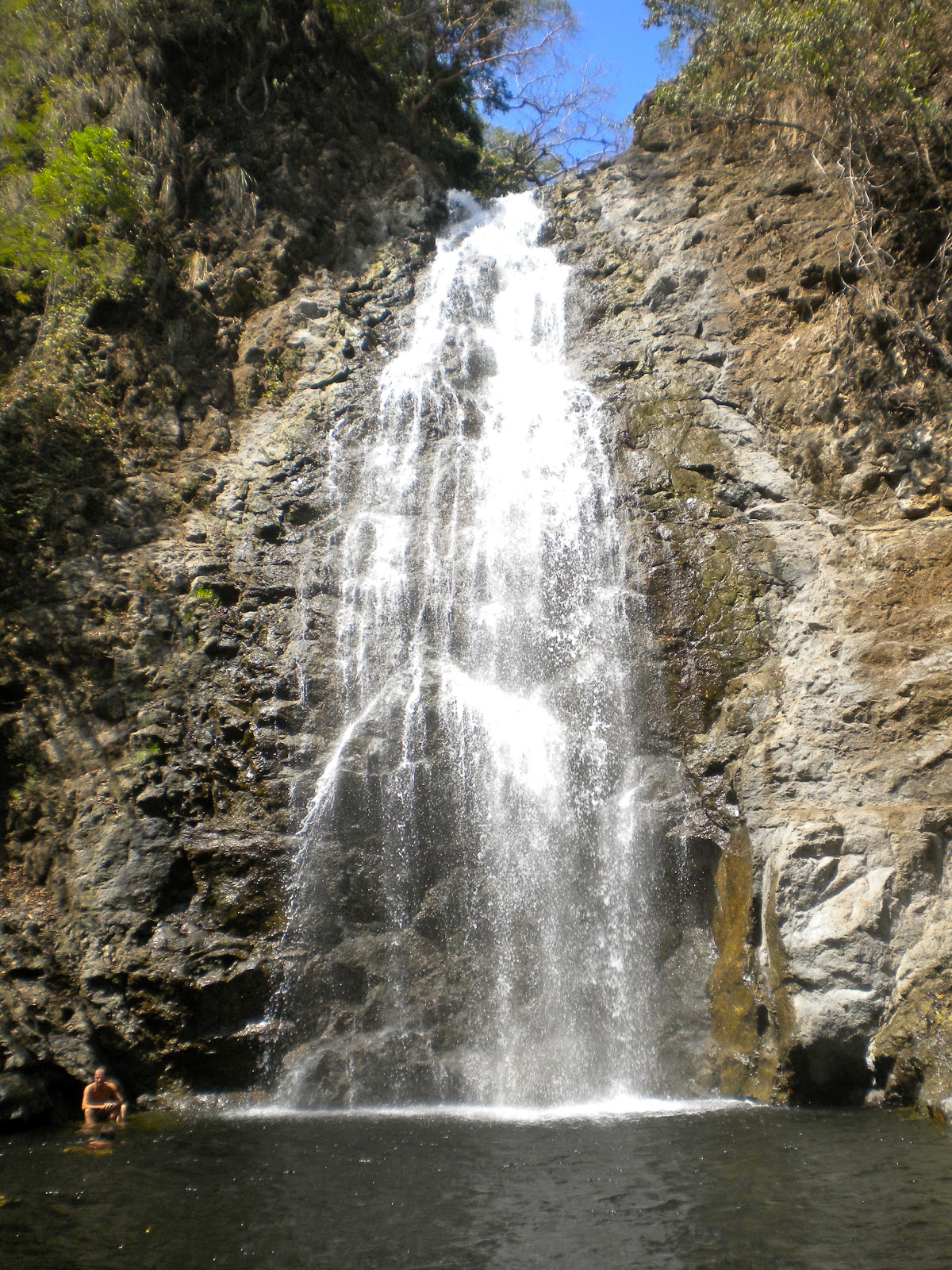
We went on a number of walks. Of course we had to check out the famous Montezuma waterfalls, and we decided to go with our Danish and British friends that we had met. The waterfalls were gorgeous, and we were able to swim and cliff jump while we were there. In the evening, we took a walk on the beach to see the sunset. Of course, any sunset on the Pacific is supposed to be gorgeous, but due to the fact that we were on the peninsula, we were told that the sunrises are better. We met up with a local Tico who walked us to a different beach where one of the rivers flows into the ocean. There was a cool monument made out of colored rocks there. We did have a little trouble getting rid of the Tico afterwards. We ended up losing him in town.
This is the entrance to the protected area.
We were not sure exactly what the rock art was about,
 but it was pretty cool.
This is where the river meets the ocean.

All four of us were hoping for a cheap weekend. The hostel and the bus ticket were not too steep. We cooked most of our own meals in the kitchen, in fact, I spent more money on water than anything else. Like I said, it was really hot there. Melissa and I did go out for one meal, and I had the best crape and jugo de cas ever! After dark, we hung out with some of the other people at the hostel. I found out that it is very easy to fall asleep in a hammock, but in the morning I had a good amount of mosquito bites. For the second night, the hostel owner put up a mosquito net for me. 
Melissa is on the left and Emily on the right.

Overall, the trip was a huge success. I had so much fun planning everything for my own trip!

This is the sunrise we saw right before returning Sunday morning.

Blog Catch Up Day- 127 Hours

First of all, I would like to apologize for the untimeliness of all of these blogposts. I have gotten "a little" behind, because I have been filling out an extensive scholarship application and working on a number of research projects for my classes here in San José.

Wednesday February 9

I had the opportunity to take advantage of yet another half off movies Wednesday here in San José. Every Wednesday, at all of the cinemas in the city, everyone only pays half the price to see any movie. I often go to the movie theatre in San Pedro near the University of Costa Rica. Movies are usually four dollars. On Wednesdays they are 2 dollars or 1,000 colones (1 mil). After my Documentary Appreciation class ended at 8:00, a whole bunch of us started walking to San Pedro to make the 9:10 showing of 127 Hours. Usually we take a public bus from near Veritas to San Pedro, but we wanted the experience of walking.... it's a bit of a hike to San Pedro.

Once we got to the theatre, we purchased the famous sweet popcorn that all of the movie theaters sell here. It is a bit of a mixture between caramel popcorn and kettle corn, and it is amazing. Luckily, 127 Hours has not been out long enough to be dubbed in Spanish. We watched it in English with subtitles in Spanish. As much as I love the experience of watching films in Spanish, I think I will stick to the animated ones for now. 127 Hours was rather gruesome, and I would not recommend it to those who have weak stomachs. I will definitely think twice before I ever go caving alone.

Wednesday was also a happy day, because I found out that I will be working at Camp Kirchenwald again this summer as a counselor :)